Help Your Child Move From
Meltdown to Calm
In Real Time
A simple 4-step guide that gives you the exact words to use when your child is overwhelmed, defiant, or shut down, so you can help them build real courage, right in the middle of hard moments.
Bonuses
Included
7-Day Money-Back Guarantee | Instant Digital Access
Does Any of This Sound Familiar?
You're not alone. Most parents feel this way, and it has nothing to do with how much you love your child.

Your child explodes over something small and you don't know how to reach them without making it worse.

You say all the "right" things. And somehow, your child shuts down even more.

School mornings, transitions, and simple requests turn into battles you didn't see coming.

You're carrying guilt because you love your child deeply, but nothing you try seems to stick.
Fear Doesn't Always Look Like Fear
When your child is acting out, refusing to cooperate, or completely checking out. Most parents assume they're being difficult. But that's almost never what's happening.
What you're actually seeing is a child whose nervous system is overwhelmed. Fear in kids shows up sideways. It looks like anger. Defiance. Avoidance. Silence. Their body is trying to protect them, faster than their words can catch up.
Your child isn't choosing to be difficult. They're having a hard time. They need you to guide them through it, not just manage around it.
The problem is that most parents were never shown how to do that in the moment. Not later. Not in theory. But right when things are falling apart.
That's exactly what this guide is designed to fix.
What Actually Helps
After 20 years working with children in high-stress, inner-city school environments, I've seen one thing that changes everything: when a child feels safe first, they can think. And when they can think, they can learn to be brave.
It's not about perfect parenting. It's not about long lectures or complicated therapy techniques. It's about having a simple, repeatable way to respond when fear shows up, so you can help your child move through it instead of being taken over by it.
Small moments, practiced consistently, create lasting change.
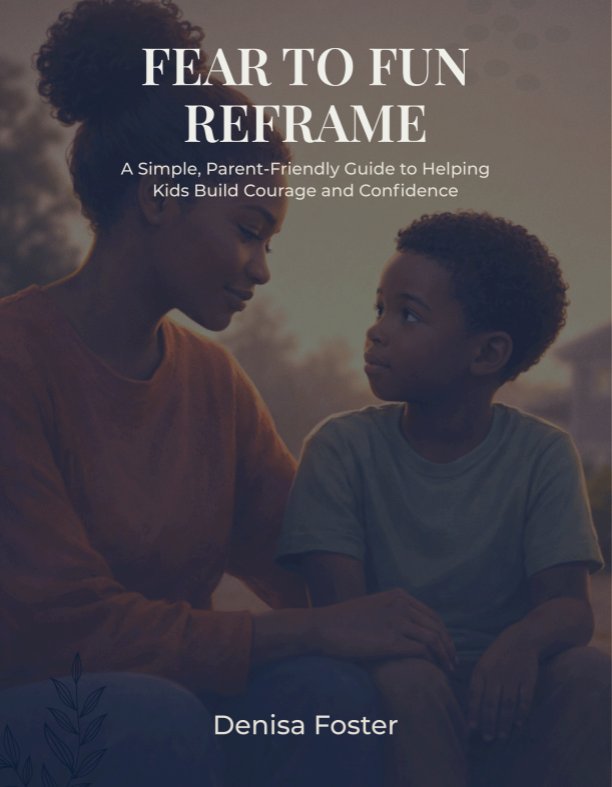
Fear to Fun Reframe
By Denisa Foster, NLP Master Practitioner & Certified EMDR Coach for Children
This is a practical, parent-friendly guide that walks you through a simple 4-step process for helping your child move from fear to confidence. In real life, not ideal conditions.
No scripts to memorize. No therapy degree required. Just a clear, repeatable rhythm you can use in the car, in the hallway before school, or in the middle of a meltdown.
Whether your child is anxious, easily overwhelmed, reactive, or just stuck. This guide gives you the tools and the exact language to help them shift.
The 4-Step Fear-to-Fun Process
Each step follows how your child's nervous system actually works. Safety before thinking. Thinking before courage.
Acknowledge the Feeling
Before anything else can work, your child needs to feel seen. You'll learn the simple language that creates safety instantly, including what to avoid that accidentally makes fear louder.
Try saying:
- I see how upset you are.
- This feels really hard right now.
- I'm here with you.
Lighten the Moment
Once your child feels heard, this step reduces the emotional weight so fear stops running the show. It's not about joking around. It's about helping their body feel less threatened.
Try saying:
- Let's slow this down together.
- If this feeling had a size, would it be big or small?
- We don't have to solve everything right now.
Reframe It Together
This is where confidence actually gets built. You'll learn to invite your child into the shift, not push them through it. When kids participate, courage sticks.
Try saying:
- What part do you feel like you could handle?
- What do you think would help right now?
- Do you want to try together or on your own?
Reinforce and Celebrate
This is the step most parents skip. It's where growth gets locked in. You'll learn the exact words that teach your child's brain: "I can do hard things."
Try saying:
- You stayed with that, even when it was hard.
- I noticed how you calmed your body.
- That took courage.
Plus: real-life scenarios for school anxiety, anger, avoidance, and power struggles. And guidance on what to do when a moment doesn't go the way you hoped.
Give Me the Tools to Help My Child →3 Bonuses That Make It Even Easier to Use
Because knowing something and being able to use it in a hard moment are two different things.
Quick Reference Guide
All four steps and their key phrases on a single card you can keep on your fridge, in your bag, or on your phone. When things get loud, you won't have to remember. You'll just have to look.
What Do I Say? Calm-Moment Phrase Guide
A full phrase guide organized by each of the four steps. Real language, ready to use, for real moments. The more familiar these feel before you need them, the more naturally they'll come out when emotions are high.
Courage Check-In for Parents
A 5-step reset guide designed for you, not just your child. Because when your nervous system is settled, your child's can settle too. Use this after a hard moment to process, reset, and move forward without the guilt.
What Parents Are Saying
[Testimonial coming soon. Space reserved for a real parent story. Replace with name, location, and their experience using the guide.]
[Testimonial coming soon. Space reserved for a real parent story. Replace with name, location, and their experience using the guide.]
[Testimonial coming soon. Space reserved for a real parent story. Replace with name, location, and their experience using the guide.]
Here's the Full Value
Every piece of this kit was designed to work together, so you're never guessing what to do next.
Your Price Today
$27
$9
Introductory price. May increase without notice.
Yes, Help My Child Build Courage →7-Day Money-Back Guarantee
If you open this guide, try the steps, and feel like it wasn't worth your $9, send an email within 7 days and you'll get a full refund. No questions, no hassle.

Denisa Foster has spent more than 20 years working with children in high-stress, inner-city school environments, supporting emotional regulation, behavior, and resilience in real-world settings.
Through that work, she has seen firsthand how fear shows up as anger, avoidance, shutdown, and resistance. And she has seen how quickly everything can change when safety comes first.
Her guiding belief is simple: when children feel safe, they can think. And when they can think, they can grow.
She created the Fear to Fun Reframe to put that knowledge directly in the hands of the parents who need it most, in a form they can actually use when it matters.
Questions Parents Ask
Your Child Is Ready to Learn Courage.
You're Ready to Help Them.
The next hard moment is coming. The only question is whether you'll have a way to respond to it that actually helps.
I Want to Help My Child Feel Safe →Instant digital access | 7-Day Money-Back Guarantee | All 4 files included